

Best Standing Desk for Small Spaces
Answer a few questions about your room and your setup, and get one pick that actually fits.
Find my matchFree to use, and there’s no account to create. We ask for an email at the end so we can send your matches to you.
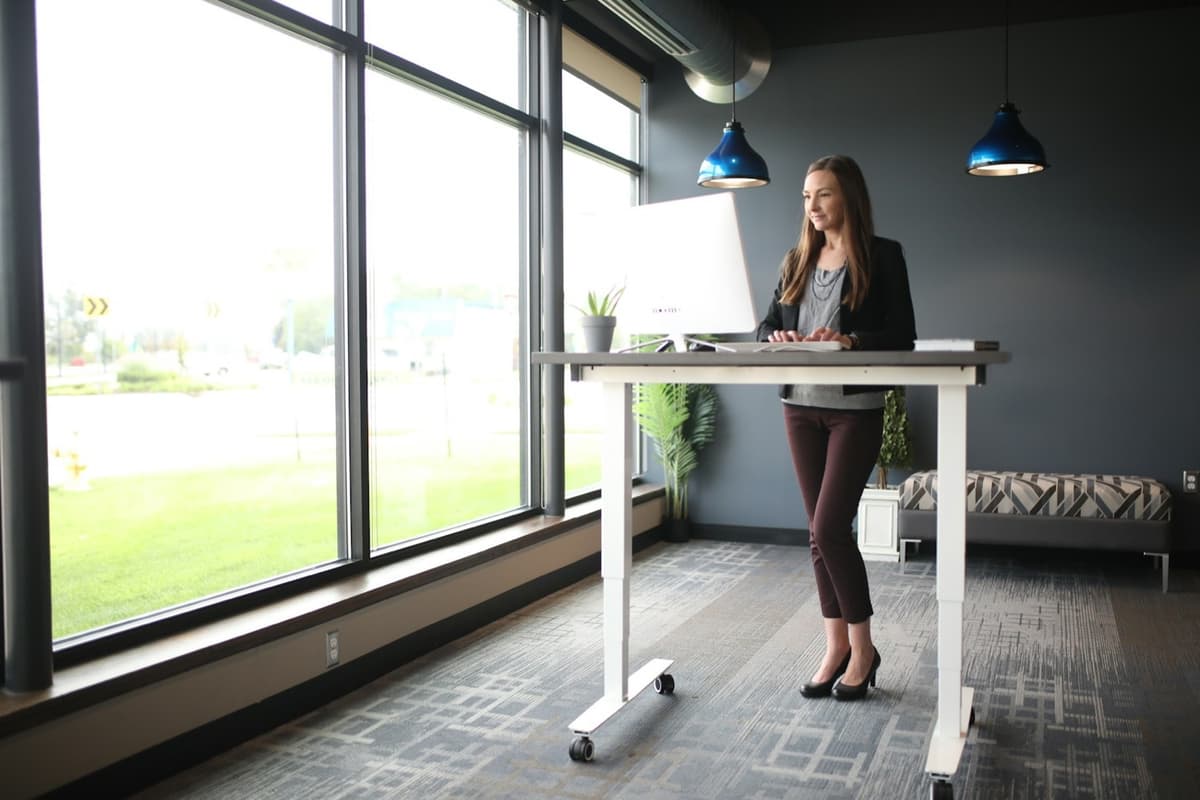
There’s no single “best standing desk” — only the best one for you.
Someone with a spare corner needs a different desk than someone standing a setup up in a bedroom that has to still be a bedroom at night.
Our AI doesn’t have a quota to fill — it has one job: finding what fits your exact needs, not the one with the best commission.
A personalized match
Not a generic top-ten list
Save hours of research
Skip the endless tabs
100% free to use
No hidden fees, no signup
Honest recommendations
Not sponsored picks
Tailored questions, not a fixed checklist
Your questions are generated for what you’re actually shopping for, and each answer shapes the next one. Here’s how it starts.
- 1
How much floor and wall you can give it
A permanent corner, a sliver against one wall, or nothing that can stay set up all day.
- 2
Full desk, converter, or wall-mounted
A small standing-desk frame, a riser that sits on a table you already have, or a fold-down desk fixed to the wall.
- 3
What has to fit on top
A laptop alone, or a monitor, keyboard and room to write — which sets the minimum usable top size.
… and more, depending on what you tell us.
The most direct answer for a small room is a compact standing-desk frame with a narrow top, roughly 40 to 48 inches wide and 24 inches deep. Plenty of makers sell frames this size, and the small ones are often single-motor, which is an acceptable trade here because a shorter top has less leverage and wobbles less than a wide one anyway. Measure the space with the desk at standing height and the chair pushed in, and remember the footprint is the leg spread, not just the top. A frame with inward-set or T-shaped feet tucks into a corner better than one with wide runners.
If even a small frame is too much, a desktop converter is the space-saving option: a spring or gas-lift riser that sits on a table or desk you already own and lifts your screen and keyboard to standing height. They cost far less, need no assembly, and can be lifted off entirely when you want the surface back. The trade-offs are real, though — they occupy a chunk of desk depth even when lowered, they raise your monitor higher than a proper desk would so a separate riser or arm helps, and the taller Z-lift models can bounce at standing height. For a shallow desk against a wall, check the converter does not push your keyboard off the front edge.
A wall-mounted fold-down desk is the smallest footprint of all, because folded it is a few inches of shelf. Some are fixed-height and some have a gas strut that gives a little range; most are not electric. They suit a laptop and light work rather than a multi-monitor setup, they need to be screwed into studs or a masonry wall to be safe, and you give up the sit option unless you pair one with a tall stool. For a bedroom or a hallway nook that has to be clear most of the time, they are hard to beat.
Corner and L-shaped compact desks are worth considering if your small space has an unused corner, because a corner is often the one place a desk does not stick out into the room. A few standing-desk makers offer compact L-shaped frames, and a corner setup gives you more usable surface for the same intrusion. The catch is that L-shaped electric frames are heavier, pricier and harder to move, so this only makes sense if the desk is staying put.
Two practical things in a tight space. Cable management matters more when the desk is inches from a wall or a bed: look for a frame with a tray or spine, plan where the single power lead runs, and on a converter route the cables so lifting it does not yank anything. And check the weight limit, because compact and converter units are rated lower than full desks — a small electric frame might take 150 pounds against a full desk's 250-plus, and a converter often tops out around 35 pounds, which a heavy monitor and an arm can reach faster than you would think.
How QuickPick works
Tell us what you need
In plain English. No model numbers, no spec knowledge required.
Answer a few smart questions
Our AI asks what actually changes the answer, then stops asking.
Get your top matches
A short, ranked shortlist you can compare side by side, with prices.
What actually changes as you spend more
Not a list of picks. Just a sense of which band you belong in before you answer a single question.
$120 – $280
FlexiSpot, VIVO and Varidesk-style risers that sit on furniture you already own. The cheapest way to stand, with no assembly, and removable. Expect them to eat desk depth, raise the monitor high, and wobble more the taller they go.
$300 – $550
Narrow single- or dual-motor desks 40 to 48 inches wide from FlexiSpot, FEZIBO and Uplift, some on casters so they roll away. A proper desk in a small footprint; you pay a little more per inch than a full-size model.
$250 – $700
Fold-down wall desks, and compact L-shaped or solid-top frames from Uplift and Fully. The smallest footprint when folded, or the most surface for a fixed corner. The wall units are usually manual or limited-range height.
Typical street prices, reviewed 2026-09-04. QuickPick shows live retailer prices on your actual matches.
Frequently asked questions
- What is the smallest a standing desk can be?
- Compact electric frames go down to about 40 inches wide and 24 inches deep, which fits a monitor, keyboard and a little writing room. Below that you are looking at a desktop converter on existing furniture, or a wall-mounted fold-down desk that folds to a few inches of shelf. The frame's leg spread, not the top, is the footprint to measure.
- Are desk converters as good as a real standing desk?
- For saving space and money, they are a reasonable compromise. The downsides are that they take up desk depth even when down, they lift the monitor higher than ideal so you often want an arm as well, and the taller lift models bounce at standing height. If you have room for a compact frame, that is the better experience; if you do not, a converter is a real option.
- Can I put a standing desk in a bedroom?
- Yes, and the question is whether it can stay set up or has to disappear. A compact frame on casters can roll into a corner; a wall-mounted fold-down desk collapses to a shelf; a converter can be lifted off. If the room has to fully revert at night, prioritise something that folds or moves over raw desk size.
- Do small standing desks wobble more?
- Not necessarily — a narrower top is a shorter lever, so a compact desk can be steadier than a wide one on the same frame. The wobble risk in small setups is more about tall desktop converters and about frames raised near their maximum. A short single-motor compact frame is usually fine.
- How much weight can a compact standing desk hold?
- Less than a full-size one, so check before you load it. A compact electric frame is often rated around 150 pounds versus 250-plus for a full desk, and a desktop converter frequently tops out near 35 pounds — a large monitor plus a heavy arm can get close to that. Add up your gear before buying.
- Wall-mounted fold-down desk or a compact frame?
- A fold-down desk wins on footprint when folded and suits a laptop and light work, but it usually has no sit option and must be anchored to studs or masonry. A compact frame gives you sit and stand and a sturdier surface for monitors, at the cost of always occupying its floor space. Your room, and whether you need to reclaim the space, decides it.
Honest recommendations — not endless tabs.
Answer a few questions and get matched in under a minute. Free, and no signup.
Looking for something else?